Showing posts with label #blacklivesmatter. Show all posts

Tuesday, July 12, 2016

Sermon for July 10, 2016: Memory Roads of Hope

This sermon was preached by Rev. Mark T. Peterson at Christ the King Lutheran Church, Holliston, MA on July 10, 2016.

Luke 10:25-37
25Just then a lawyer stood up to test Jesus. “Teacher,” he said, “what must I do to inherit eternal life?” 26He said to him, “What is written in the law? What do you read there?” 27He answered, “You shall love the Lord your God with all your heart, and with all your soul, and with all your strength, and with all your mind; and your neighbor as yourself.”28And he said to him, “You have given the right answer; do this, and you will live.”
  29But wanting to justify himself, he asked Jesus, “And who is my neighbor?” 30Jesus replied, “A man was going down from Jerusalem to Jericho, and fell into the hands of robbers, who stripped him, beat him, and went away, leaving him half dead. 31Now by chance a priest was going down that road; and when he saw him, he passed by on the other side. 32So likewise a Levite, when he came to the place and saw him, passed by on the other side. 33But a Samaritan while traveling came near him; and when he saw him, he was moved with pity. 34He went to him and bandaged his wounds, having poured oil and wine on them. Then he put him on his own animal, brought him to an inn, and took care of him. 35The next day he took out two denarii, gave them to the innkeeper, and said, ‘Take care of him; and when I come back, I will repay you whatever more you spend.’ 36Which of these three, do you think, was a neighbor to the man who fell into the hands of the robbers?” 37He said, “The one who showed him mercy.” Jesus said to him, “Go and do likewise.”

Greetings to you from God our Father, and the Lord Jesus Christ,


As many of you probably know, I was on vacation last week, going back to Minnesota, where we stayed with my sister, in southeast Minnesota for most of the time we were there. As anyone who has ever journeyed back to where they are from can attest to, when you drive on the old roads you grew-up on, many memories start coming back. One particular afternoon, my brother and I, along with Charlie and our nephew, drove down County Rd. 10. We remembered all of our neighbors who lived in each house, and we drove by the house I grew-up in; reminiscing the whole time. As we drove further down that road, the four miles into the small town of Dover, I told the kids about the time my friends and I rode our bikes to our middle school, on the last day of school. As we proceeded to cross the treacherous Highway 14, my brother and I both agreed we'd never allow our kids to do that today...it was a different time then! We continued though, driving along the back road into Eyota, by the "new" elementary that was built over 20 years ago. We stopped at Dover-Eyota High School, to see the pavers and bricks that had recently been laid there, especially the one we as a family bought and dedicated to my mom, who was a teacher in the district. Being back on the roads of my youth brought back a lot of memories and it was great to be "home" for awhile. 


Today, as we read Jesus' parable known as the Good Samaritan, it's sort of like a Biblical memory road for us. It is a story we are very familiar with, it's even a part of our culture..if someone does a good deed for someone they don't know or who is different then them, we often call that person a "Good Samaritan." And, this memorable story takes place on a road, a road from Jerusalem to Jericho. We may not be real familiar with this particular road, but we have strong memories of what happened on it, a violent act, an act that left a man robbed, beaten, and broken. We also remember the people, the "holy" ones, a Levite and a priest, and we remember we don't want to be like these people, who pass by the injured man rather then help him. We remember that we want to be like the Samaritan, the one who was a neighbor to that person in need. The parable of the Good Samaritan, is a very much a part of our memories. 

It is our memories that help connect us, now in the present, across the time and space of our lives, and it is our memories that bridge us to the future. 

On my last day in Minnesota, we had moved our base of operations to the Twin Cities, and in the morning I went to have breakfast with my friend, J. As we started talking, J asked me if I had heard what happened the night before on  yet another road, a road that I had lived next to, and driven on often. He started telling me about events that had happened on Larpenteur Avenue, very close to its intersection with Snelling Avenue. He told me that a young man, Philando Castile, had been pulled-over there, and that his life had violently ended, that there was video up on social media, and I was a bit shocked, as I remembered that I had worked at a restaurant that was right next to where this awful and violent tragedy took place. I remembered being in the area, and driving up and down that road many times, and never once feeling any sort of danger. 

As we reflected on what happened, other memories came back as well. Memories of the "Oh No!" kind. Memories of all the similar events that have happened so recently, (and probably occurred at the same rate in the past, when we weren't as connected with technology), and a memory of such a similar event that had happened in Baton Rouge, where Alton Sterling's life had ended so suddenly and violently. Memories that keep piling up, memories that cause grief and unrest, memories that you don't wish upon anyone. 
Still trying to make sense of the conflicting memories I had, of working and living in a place that was so safe for me, but not someone else, I was wondering how such a thing could happen there. And how such a thing could keep happening in our society. Then, on the very next day, the violent events of Dallas happened, where 5 officers violently have their lives taken from them, with others wounded, and so much fear all around. 

As we read this parable, about the Good Samaritan, taking place on that road from Jerusalem to Jericho, a road that I believe you can travel on today if you visit that area, a road that whether we've been there or not continues to play in our collective memory. Today, we all have different roads in our life and culture, that we've traveled on either metaphorically or literally, but it seems as if our collective, virtual road, the one that we travel on together as a society is a lot bigger and more connected than in the past. Over the past week, and even over the past weeks, this road has been filled with violence, pain, and suffering, things that tear us apart as a society, things that cause us to question what it is we base our lives on, what it is we know and don't know. 

In weaving together the story of the Good Samaritan and recent events, we want to become like that Good Samaritan, we want to do something to help, and we certainly don't want to be like the Levite and priest, who leave the man to suffer. In my own memorable reflections on this parable, trying to be like the Good Samaritan has always been what has been impressed upon me. Yet, in times like these, it can be hard to be the one, the Good Samaritan we are supposed to be. Maybe, it's because we don't always know what to do, or what is right. Or, perhaps, it's hard because the world, and its violence can seem so overwhelming, and there's so much going wrong with it. Perhaps, we just feel so far away from all of this violence, even something that happened so close to where I once lived and worked. How do you be the Good Samaritan, as painful memories keep being made, memories that don't provide a bridge to the future, but cause it to be so uncertain? 

We ask, how do we be the Good Samaritan, but this morning, let's try a little different take-away from this memorable story. Rather than ourselves as the Good Samaritan, let's replace him with Jesus, and instead of the Good Samaritan, how about we recognize ourselves, as human beings, as being like the man who is by the side of the road; robbed, beaten, broken, and in need of help. The man who now must certainly distrust this world, who fears it, the one wondering where our help will come from. As we make Jesus into the Good Samaritan, we remember what motivated him, we remember that this man was moved by his pity, or compassion, for the one who was left for dead, the one who was not only a stranger, but a Jew, the arch-enemy of the Samaritans. When we start to view Jesus as our Good Samaritan, we see our Lord, our God, who is moved by compassion for us, a God who feels our pain and brokenness, our despondency and despair, our injustice and anxiety; the things that are a part of our lives and society and which leave us in need of help. We know that our Lord, who feels such compassion for us don't just pass us by on the side of the road, but is moved to come to us, and give us his life, his love, his healing, and his HOPE. This is the hope that doesn't wait for the road to be safe, or for the time to be right, but is a hope that is shown to us on a cross. A hope that makes the time right, that makes our lives filled. This is the hope, the compassionate hope that is given to us, and the hope that will enliven us once again. This is the hope that indeed shows us the mercy of God, the hope that springs forth from the merciful actions of a Good Samaritan. 

Therefor, as we look upon our world today, we see a world that is as filled; filled with sin as it was 10 years ago, or 100, or even 1000 years ago, a world that is filled with fear and hatred, filled with injustice, filled with uncertainty. In such a world, it is hard to be that Good Samaritan that is a part of our memory, indeed, what are we to do? Called by the Holy Spirit, we are to come together to dine on the life of our Good Samaritan, to be filled with his compassion, to taste and see his mercy, so that we can give this mercy to others. We are called together to pray, to pray to this compassionate Lord, to be moved by the compassion which so moves him, so that the world may have hope, so that the world may know mercy. 

As we continue to come together, to KNOW of this mercy more and more, as we GROW in our prayers to a God who acts in such a way towards us, we see that this compassionate love, that this mercy, that this healing and health and life is for all people, no matter what. We see this mercy, and by it we GROW, being transformed to give this abundant mercy that has been given to us. This is the mercy of the Good Samaritan, the mercy which fills us so much, that it overflows onto others. This is the mercy that isn't passive, that doesn't sit on the sidelines. Rather, this mercy is active, it goes to those who are hurting, those who have been marred by injustice simply because of what they look like, those who are filled with fear and anxiety over their loved ones who spend their lives working to keep others safe, those who are just confused or lost. This mercy of God is active, it gives us life, it gives us love, it gives us hope. Today, God is here once again, to fill us with this mercy, with this love, with this life, so that we may go and do likewise. For this we give thanks!


In the name of the Father, Son, and Holy Spirit,
Amen


Thursday, July 16, 2015

Ask the Pastor: what is the reason we should be intentional in our multicultural efforts, especially towards African Americans? (a question from Rev. Dr. Julius Carrol)

The question below was presented for response in a Multicultural Ministry seminary class I took,taught by Rev. Dr. Julius Carrol
“Pastor, please give us a rationale as to why you believe this congregation, has been call to reach out to the African-Descent community.” 

As a Congregation that is overwhelmingly white, in a denomination that according to 2008 figures is 97% white, any attempt to be in community with those who look different then us will cause an intentional reaching out to that intended community.  This is because in ELCA congregations, we have become accustomed to doing things that speak in a unique manner to only those who have been raised in a European, mainline Protestant context.  Thus, in order to speak a new language we must learn a new language, and in order to learn a new language, we must be intentional in our study, practice, and development in that language.  Our rationale for undertaking this venture is to engage with our fellow members of the body of Christ as a community, so that we can live together as the One, crucified, body of our Lord and be that Body as a light in the world. 

It is indisputable that we as Christians belong as full-members to the Body of Christ regardless of race, class, ethnicity, or sexuality.  Though this may seem elementary, it is important to break down once and for all any conceptual walls that one may have about who belongs to this body and how much they belong. It is important to stress and teach about the unity we share in Christ, as Paul writes to the Galatians, “There is no longer Jew or Greek, no longer male or female, no longer slave or free; for all of you are one in Christ.” (3:28)  Despite this unity in Christ, Paul also writes that we have all been given different spiritual gifts, saying “For as in one body we have many members, and not all the members have the same function.” (Romans 12:4)  When we start as Christians with the understanding that we are One, though not the same, as the Body of Christ, we then can move into a discussion of how to better function as that Body for the world. 

Though unity in Christ is what we’ve been given, we have grown as a Body where the hand and the foot do not know each other; a body where the mouth consumes food which damages the stomach.  In order to work together, we must first get to know each other and so that we can better care for the Body. 

This process of getting to know each other means that we go and meet people where they are at, and do not wait for them to meet us, whether this is a literal meeting or an intentional listening.  Holy Scripture is filled with examples of people going, Phillip was sent by the Holy Spirit to go to the Eunuch’s chariot, Jonah was sent to Nineveh, and Mary was called to sit and listen to the words of her Lord. 
As this Body, we do not get to know each other to become exactly the same.  Rather, we meet each other to find the ways in which our different worlds connect.  Paul’s letter to the Galatians exhorts them to be Christians as they are, and not by adopting Jewish rituals.  A powerful example is Jesus meeting the woman from Samaria at the well in the Gospel of John.  In this story, Jesus does not convert the woman and in fact, breaks tradition by asking for water from this enemy of Judaism.  It is around this practice of drawing water that Jesus tells this woman who he is and also that he knows her.  The woman then tells her community, and many Samaritans see Jesus and believed.  Jesus met this woman and broke into her life and community with his light, not around shared rituals, but around the necessary practice of drawing and sharing water from a well.  We too, are called to become one, proclaiming with both Samaritan and Jewish voices that our Messiah has come.

A modern-day example of someone that has gotten to “know” people in the name of Christ is Jean Vanier.  Mr. Vanier has done work amongst the developmentally disabled, and through this work has opened up the doors of communication and relationship between these people and other members of the Body of Christ.  When Mr. Vanier began his work in the 1960’s and moved people from an institutional life to one of authentic community, there situation was improved. 

The real testimony does not lie in this move from institution to community of individuals, rather it lies in the new ways that Christians across the world have heard of and shared in Christ with people who are different in many ways, but who are all made whole in Christ.  As Douglas John Hall mentions in his book, The Cross in our Context, Vanier has been a leader for Christians who engage the world, rather then create a haven apart from the world. (53)  In Vanier’s context, these havens were the sanitary institutions where we put those who would be disruptive to our safe lives.  This engagement is what we are called to as the body that proclaims Christ crucified.

Within The Cross in Our Context, Hall references the legend of Quo Vadis.  In this legend, Peter the Rock is fleeing Rome for a safe haven when he encounters the resurrected Jesus on the road, who is going back to Rome.  When Peter asks where he is going, Jesus says to Rome, to be crucified again.  The above example using Vanier is simply one of many who go into the dangerous places not to save the world, but to be crucified by it. 

As we discuss our relationship with those of African-Descent in our country, (and especially focused on African-Americans) we must ask ourselves what does it look like for us to go back to Rome, and are we going there to put out the fire or to be crucified because of it.

The answer, or an example to these questions is not found within ourselves as the ELCA.  We as a denomination, have, by and large, already fled the fire of race relationships for the safety of suburbs and gated communities.  Instead, we would do well to look to the obvious people to guide us, the courageous leaders and people of the Black church.  It is people like Martin Luther King Jr. that have brought the knowledge that Rome is burning to us through their own persecution and crucifixion as icons through which we can see the Crucified Christ.  It is because of the bravery of the Civil Rights leaders to challenge the status quo that we as a could see the light and love of God through them and not through an apathetic view that hierarchal security is the way of God’s love.  When the world saw dogs and fire-hoses turned upon children because of the color of their skin, they were shown the sin that exists in humanity.  Yet, because they were able to see this sin, people were also able to see the love of God for all humans and to better understand the gift of humanity we have been given.  The gift that is so precious, that God lived with us and died as one of us for it. 

Though there was great progress in recognizing the gift of a basic, common humanity given to us by God in the middle part of the 20th century, a great deal of pain continues to exist among the African-American community.  Clear evidence for this continued pain unique to the African-American community is provided by simply looking at demographics which show greatly disproportionate rates between races in regards to poverty, high school drop-outs, imprisonment, and life-expectancy (to just skim the surface).  We as Christians believe the promises of God to us and because of these promises we know the crucified and suffering Christ is present in the African-American community.  Unless we simply describe these differences away using racism, we must acknowledge that these circumstances are the result of an unjust society.  In acknowledging this injustice, we as Christians, especially European-American Christians must acknowledge the sin that exists in this society.  As we make these acknowledgements, we begin to see Christ, with all of his horrible wounds, crucified in the unique wounds of this community, suffering with the humanity that he loves. 

As stated before, because of Christ, all are made one into the Body of Christ.  Thus, when our sisters and brothers in Christ suffer, we suffer as well.  This is the case even when we cause the suffering of our own body, just as we as humans caused the suffering of our own God.  Because we are united, yet broken, we share as one the stories which God has given to us through our lives.  Through these stories of God’s interaction in our lives, we see more and more the creative power breaking into the world in new ways.  As these stories of humanity weave themselves around the oneness we share in the Crucified Christ, God weaves hope and promise through the people of God for the world. 

When we remain tied to our own way of doing things, for fear of others in the world; or worse yet for fear of seeing the result of our sin on the lives of others, we lose the richness of the mystery which God comes to us in.  The stories of God’s work in the lives of the African-Descent community are screaming to us to hear them and to discover the grace of God in these stories.  These stories cry out to us through spirituals and rhythms which give the story of the Hebrew people a literal context.  These stories cry out to us through the warnings of the Prophets when they yell that there are two America’s, and that God condemns this country we have created in our own image.  God is calling us to hear these stories and to experience Christ in solidarity with our brothers and sisters who we hardly know. 

The work of Christ on this Earth is the ideal function of compassion, or with-suffering.  As Hall writes about the German word for compassion mitleid and its action is to be “thrust into a solidarity of spirit with the other – to experience, in one’s own person the highest possible degree of identity with the other” (22)  This is what Christ has done with humanity, he has become one with us, ultimately in his death on the Cross.  This unity is why we are called to be multi-cultural, not out of pity, but out of a grace-filled calling to be unified with each other and with our God.  We are called to be unified in this suffering, so that we can be Christ’s crucified people so that all may see through us, God’s compassion for the world. 

Monday, June 29, 2015

Sermon for June 28, 2015: Repent, the Room's Only Half-Painted

This sermon was preached by Rev. Mark Peterson at Christ the King Lutheran church on Sunday, June 28, 2015. Our service was one of Repentance and Mourning, in the wake of the killing of 9 people at Emanuel AME Church in Charleston, SC on June 17, 2015.

Matthew 5:1-10

When Jesus saw the crowds, he went up the mountain; and after he sat down, his disciples came to him. 2Then he began to speak, and taught them, saying:
3"Blessed are the poor in spirit, for theirs is the kingdom of heaven.
4"Blessed are those who mourn, for they will be comforted.
5"Blessed are the meek, for they will inherit the earth.
6"Blessed are those who hunger and thirst for righteousness, for they will be filled.
7"Blessed are the merciful, for they will receive mercy.
8"Blessed are the pure in heart, for they will see God.
9"Blessed are the peacemakers, for they will be called children of God.
10"Blessed are those who are persecuted for righteousness' sake, for theirs is the kingdom of heaven.

Greetings to you in the name of Jesus Christ,
I opened by reading this a letter from ELCA Presiding Bishop, Elizabeth Eaton, found here.

Rev. Elizabeth Eaton,
 Presiding Bishop of the
Evangelical Lutheran Church in America.
On Wednesday of this week, I received this email...a mass email, the Presiding Bishop doesn't just email me personally. It was an email talking about this day of Repentance and Mourning, with the above letter attached, and I opened the email, and sighed, as I thought about how we had just had a theme like that to our services at Christ the King last Sunday. A day when I shared some of my own personal connection to this tragedy, as I knew and was a friend to Rev. Clementa Pinckney in seminary. It seemed like we'd already done this, and I was thinking about being outside for the first time and joining together as One, I really didn't want to do this today.

But, we are a people Chosen to Proclaim, and part of our proclam
ation is being in unity with something greater than ourselves. Of course we are in unity with God, but a reflection of that is our unity with our fellow ELCA congregations in our synod, and across the nation. Our Presiding Bishop is our leader, and so as an expression of our unity, it is good for us to join together in this day of Repentance and Mourning, just as we'll join with the ELCA in September for God's Work, Our Hands Sunday.

In an act of civil disobedience, Bree Newsome
 takes down the Confederate Flag
that flew at the South Carolina State Capitol
And so, I was sort of over the hump of hesitancy about doing this Service of Repentance and Mourning, and then something else hit me. I was kind of shocked, by my own fearfulness and callousness, my own desire to so quickly move on, from even a tragedy that affects me, on a personal level. I thought about how, in the celebrations of these lives that were lost, as the people have really come together, especially in South Carolina where I lived for almost five years, as it looks as if a great symbol of hatred, the Confederate Flag, is finally going to be taken down. A symbol that I would see frequently, as the state capitol, was not far from the seminary. As the people came together this past week, it seemed as if the work around racism was going to be finally accomplished. But throughout this great coming together, there has been a constant drumbeat that the work is not over, our problems aren't solved, and that coming together over this tragedy and a renewed focus to ridding ourselves of racism and racist symbols is wonderful, but this work needs to continue. 

So, I was a little shocked, when I heard those messages of the work needing to continue and agreeing with them, and then found myself thinking, "well, we don't really need to do that here in Holliston. Here at Christ the King." I was shocked by my own response, and it really speaks for itself. It speaks to our need to continue to remember, to continue to do the hard work of self-examination, about where we are in error in this country, and our own contributions to that error. Also, to examine just how in our day to day lives and goings-on, we contribute to a system that has not been founded on equality. The work needs to continue.

In thinking about this issue of race, I thought about what happened just a little before my time. It seems to me, that we as a society in general feel as if we've settled these issues over race, with things like the passage of the Civil Rights act, the marches that took place, and the movement as a whole. We feel that racial discrimination is a thing of the past because we've outlawed it in this country. The work though, is not complete.

The way we've dealt with race issues in this nation, is as if we were re-painting a room. While, it seems like the majority of the work is basically over, because we've gotten the main walls painted, and the room does look a lot different, there's more to do. There's now taking care of touching up some of the little areas, doing the trim work, and cleaning-up. The parts of painting that are real tedious, and take much longer than we think, or maybe that's just me, as I never seem to give enough time to complete any task. It seems like these things are just small potatoes, in the large body of work, and no one is real eager to start on them, like perhaps they were to take care of the bigger parts, that someone notices first. Yet, until this secondary work is done, the work is not complete, and the room while looking different, still remains a mess. 

This is what our work with racial inequality is in this country. It needs to be continued, and moved forward. It hasn't been completed, and the party responsible for leading the way on the work that remains is the Church. We are called to lead this work not because it makes us feel good, or even because it's the "right thing to do". We are called to lead this work, because the completed result of this work is the vision of the Kingdom of God. A vision of a people and creation living together in peace, justice, and in love. A place, a kingdom, where no one lives in fear. Rather, a place where each person lives with an abundance, and with dignity. 

God is at this work, and God is calling us to join in this work. God is calling us to repent. To be clear,
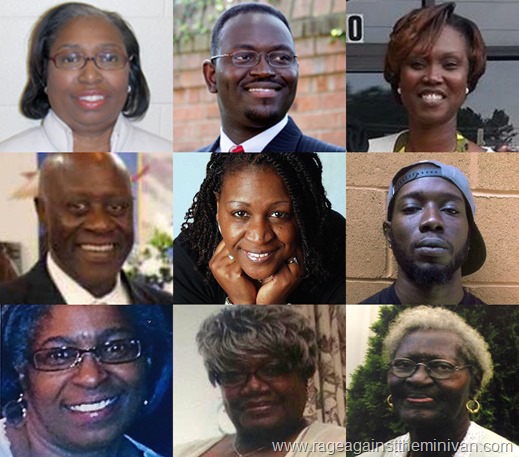
Top row: Cynthia Hurd, Rev. Clementa Pinckney, Rev. Sharonda Coleman-Singleton 
middle row: Daniel Simmons, Rev. Depayne Middleton Doctor, Tywanza Sanders
Bottom row: Myra Thompson, Ethel Lee Lance, Susie Jackson
the repentance that God calls us to, is not necessarily to feel ashamed, or sorry; or to not be proud of who we are and how we've gotten there. The repentance God is calling us to, is to turn and look at the world and admit to ourselves that the work is not yet done, and that God is calling us to join in the work that remains.

We are called to a repentance to turn and see that our sisters and brother, who don't look like many of us, experience this world and this country in a unique way, and often, that experience is not on equal terms as us. 
We are being called to repent and join our sisters and brothers, to be peacemakers and bridge the chasm that exists between us. We are being called to bridge this chasm not by saying "come and join us", but by joining others, in their walks, in their lives, and in their perspectives; by joining others in their sorrow and grief. 

Why do we need to repent?
Not too long ago, I was given a subscription to Ancestry.com, and in doing family research, there is a good possibility that one, (that I know of anyway) of my lines was a slave owner. While this discovery wasn't a real big issue for me in this time and place, I don't even really know if it's true, and doesn't seem to have any effect on me, I then thought about something else. My reflections turned to my Great-Great-Great Grandfather, Truman Payne, who had three different wives and four different marriages. My Great-Great-Great Grandmother was Truman's second wife, and yet in Truman's obituary, she's never even mentioned. I've previously wondered how this brokenness affected the lives of my Great-Great, my Great, and even my Grandmother, and consequently, how this family history has played into my own life. 

We are much bigger than ourselves, and while much of the past that makes us up is good, there are parts that can be tough to reckon with. Yet, looking at our past helps us to better understand who we are as we examine the roll it plays in making us the people we are in the present. 
When we examine our country's past, and think and show some empathy; we empathize with those whose ancestors were bought and sold, whose grandparents knew their place in society, whose parents were told where exactly it was that they could buy a house. These are the people today, who are told to be proud of their history and culture, and yet even today, often suffer if they are too proud, if they openly display their own "blackness" too much. 

We are a part of this society, and it is time for us to repent, and continue the hard work of self-examination, and to walk with those who view society with a different lens than the one we've been given. It is time to join our sisters and brothers of color in their walks, because Jesus is walking with them. It is time to join with our sisters and brothers in their walks, because Jesus is walking with us in order that we may join in the blessing of those who are the subjects of the Beattitudes.

One final piece that I would like to share. When I was in Columbia, SC, my friend Scott and I went to one of the little neighborhood, storefront type churches that were around the seminary. We did this to complete a class assignment of going to a worship service at a congregation in another denomination. The church we went to, like many in our neighborhood, was a black church. The service was about three hours long, and we were the only people in the service who were white, and yet, I've never felt more welcomed in a house of worship, than I was that day. 

We weren't only greeted by friendly people, but by people who actually cared that we were there. People who showed us where we were in the service, helped us to understand what was going on in the service, and spoke to us after the service in a way that made us feel as if we were guests, leaving the house of friends. The welcome we received was one of true friendship, and it was and is very humbling. 

Emanuel AME Church, Charleston, SC.
So, as we as a society, as a church, as even a pastor, are in danger of moving on from such tragic events, we remember that moving on isn't the way of the Kingdom of God. Instead, it is through repentance, and transformation, and a fuller reliance on the love that has been given to us, and will continue to be given to us, that will bring about this Kingdom. 

On this day of repentance, we join in mourning over the violence and loss of life in Charleston. We join in the mourning of a broken society, and our broken communities. And in our mourning, in our dark night, we wait with hope, because we know that as the Psalm says, "Joy comes in the morning." 
We give thanks today for the witness of all, the victims, the families, and so many others involved, who have shared God's love. We ask that their witness and grace may fill our lives, so that we too may witness to the One who is Lord of all, Jesus Christ.

In the name of the Father, Son, and Holy Spirit, 

Amen

Sunday, June 21, 2015

Sermon for June 21, 2015: #blacklivesmatter

This sermon was preached by Rev. Mark Peterson at Christ the King Lutheran church on Sunday, June 21, 2015. On June 17, an armed man murdered 9 people at Emanuel AME church in Charleston, SC. Among the dead was the pastor of Emanuel, Rev. Clementa Pinckney. 

Gospel: Mark 4:35–41
 35On that day, when evening had come, he said to them, "Let us go across to the other side."  36And leaving the crowd behind, they took him with them in the boat, just as he was. Other boats were with him.  37A great windstorm arose, and the waves beat into the boat, so that the boat was already being swamped.  38But he was in the stern, asleep on the cushion; and they woke him up and said to him, "Teacher, do you not care that we are perishing?"  39He woke up and rebuked the wind, and said to the sea, "Peace! Be still!" Then the wind ceased, and there was a dead calm.  40He said to them, "Why are you afraid? Have you still no faith?"  41And they were filled with great awe and said to one another, "Who then is this, that even the wind and the sea obey him?"

Greetings to you in the name of Jesus Christ,

Over the past couple of weeks, I’ve been working on integrating a theme into my sermons, and into our life together here at Christ the King. This theme is “Chosen to Proclaim”. We have been chosen by God, chosen to be the people of God, chosen to know God, so that we may proclaim with our whole lives the abundant life God has given to all of creation. We have been chosen to proclaim the unending grace and love of God, as it has been given to us in Jesus Christ.
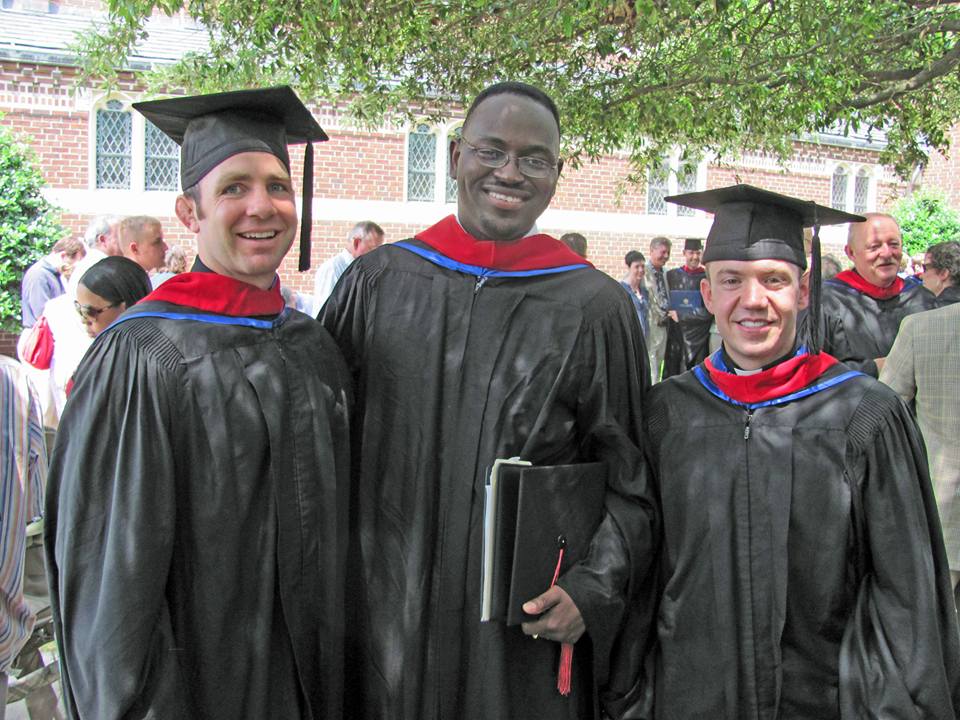
Myself, Rev. Clementa Pinckney, and Rev. Rick Reiten. 

Truly, we are a people, “Chosen to Proclaim.” Of course, part of our proclamation is confession, as we confess that we are chosen not because of our own merits, but by the grace of God. This morning, as we started our service, we said as part of our confession, “that we have looked the other way, when action was needed.” As a people “Chosen to Proclaim”, confession is a part of our proclamation.

This past week, like many of you, I woke up on Thursday morning, to the tragic news from Charleston, where the lives of 9 people were ripped away from them, as they gathered for bible study and prayer. I was in a state of disbelief as I read the text message from my friend, that said Clem Pinckney, a classmate in seminary, the keynote speaker at our graduation, a gentle, kind pastor, and a friend, was among the dead.

I’ve been praying, for this situation, and all involved, and I have been blessed by your prayers even for me. In the past few days, I’ve prayerfully struggled over the proclamation that I was being called to give this morning.

You see, in the wake of yet another tragedy, with an all too familiar theme, I confess that I struggle to proclaim the Word of God that has been given to me. I feel great temptation to stick to the safety of the distance we have from this tragedy, in both a literal and figurative sense. Charleston is a long way from Holliston, and our greater MetroWest communities. And, while we join in our nation’s collective grief, we also have the luxury to compartmentalize things like these, and leave the actual confrontation and dealing with the issues surrounding them, for someone else.

But for me, these events aren’t a long ways away. When someone you know, someone who you can remember nice conversations with in the tranquility of a seminary campus on a beautiful autumn night, is on national news because his life has ended in tragedy, things become surreally personal and painful.

So “this day,” just as the Bible says, “on that day,” Jesus commands us, “Let us go to the other side.” Let us venture from our safety and comfort, so that we may be with our Lord.

But, as we leave the safety of Holliston, still the storm rises-up within me, the winds of doubt and fear continue to blow-in upon me. Like the disciples, as I have prayed and struggled, I have questioned Jesus intentions, was he really calling me to preach these things, is he really calling upon me to say what God has laid upon my heart? As I question Jesus, I’ve continually been answered by him, with an old picture I was sent of myself, and my friend Rick on the day of our seminary graduation, and in between us, with a warm smile, was the Rev. Clementa Pinckney.

Seeing this picture, suddenly calmed the storms of doubt and fear that I had, as Jesus proclaimed to me the truth, and made this tragedy make sense. In that picture, were three men, who would all be pastors, and one of them is now dead, not because of some random act, but because of the color of his skin.

The taking of those 9 lives in Charleston was not a senseless tragedy. It is a tragedy that makes perfect sense in a world, in our nation, a nation where hatred, fear, and violent oppression, were not only at one time accepted, but were the law of the land. This tragedy makes sense in a nation that has torn the bloom off the poisonous plant of racism, but still refuses to take the steps needed to uproot it. This tragedy makes sense in a nation where the underlying current of racist feeling is so strong that it turns a blind-eye to the brokenness of a system built upon the privilege of a white person, like myself. The perpetrator of these acts, extreme as he may be, is unfortunately a natural by-product, of the system that our sinful, human hands have created, a system centuries in the making, and a system we are too afraid to confront.
We are a people, Chosen to Proclaim, our proclamation is Jesus Christ, and while he loves us so much he would die for us, and while he comes to us, no matter what, and feeds us with his merciful body and blood, the Jesus Christ that we have been chosen to proclaim does not let our sinful systems stand. Instead, through his transforming grace, he brings about change, he brings about a new creation where there is no longer Jew or Greek, male or female, white or black, but only One people, made into Christ’s body.

Though we proclaim our desire for this unity, though we denounce overt racism, prejudice, and discrimination, at this time, in this nation, even right here in Holliston, that proclamation is not enough. The proclamation that God loves everyone, and that all are equal before God, is not a statement of faith, merely a platitude, if we don’t follow Jesus in actively bringing about that reality and sharing it with our lives, especially in favor for those who are oppressed and pushed to the margins of society by the normal functioning of our broken system.

When I think about the life and love of Jesus, that we have been Chosen to Proclaim, the easy thing to say, is “All lives matter”, and we know that this is true. But as I think about that picture, as I stand here before you today; I know that society values my life, and the life of my family. It seems that our society, our broken world, still hasn’t gotten the message that indeed, #blacklivesmatter, just as much as my own.
We are “Chosen to Proclaim”, and we have proclaimed in our confession the sin of looking the other way when action was needed. We are “Chosen to Proclaim” that by his loving grace, Christ takes away our sin, and empowers us to act with righteousness and justice.

In the wake of the death of these 9 people, in the witness of their families to God’s mercy and grace, as we remember the way they stood in front of the man who killed their family members and said, “I forgive you” to him, through these saints, may Jesus open our ears to the cries of injustice, from those who are oppressed, and may he stir-up in us his powerful love, so that our words, our actions, and our lives will proclaim the truth about our broken world, the truth about our own privileged place in it, and the loving God who is transforming it.

In the name of the Father, Son, and Holy Spirit,
Amen